Bitonic Sort in CUDA
Bitonic Sequence
A sequence a0, a1, ...... ,an-1 is bitonic if
it first monotonically increases and then monotonically decreases:
a0 ≤ a1 ≤ .... ≤ ak
ak ≥ ak+1 ≥ .... ≥ an-1
e.g. 8, 10, 14, 20, 30, 45, 40, 36, 28, 15, 2
 or it first monotonically decreases and then monotonically increases:
e.g. 9, 8, 3, 2, 4, 6, 7
or it first monotonically decreases and then monotonically increases:
e.g. 9, 8, 3, 2, 4, 6, 7
Bitonic Sort
and the other in descending order
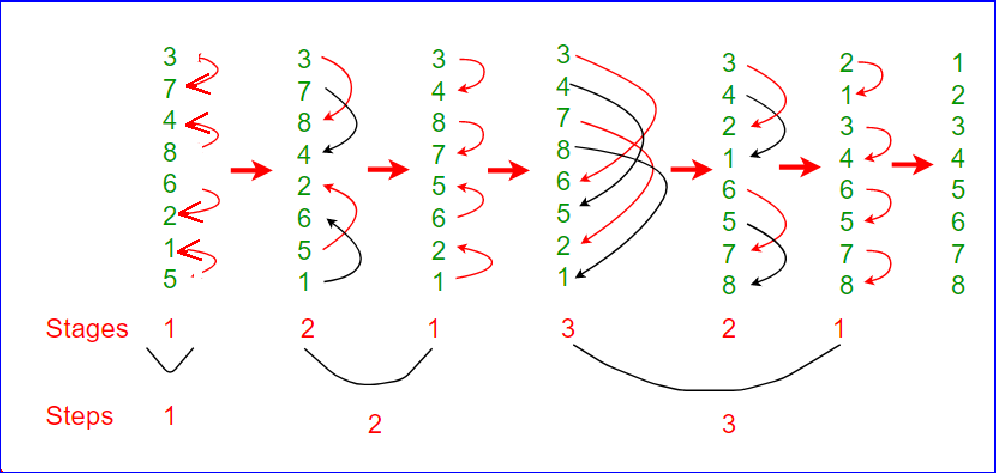
Example: Sort sequence: 3 7 4 8 6 2 1 5
- start with segment length = 2
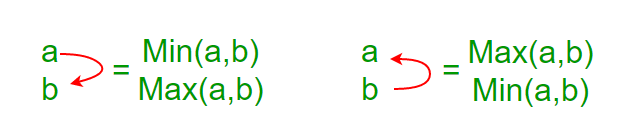
sort in ascending order sort in descending order
C/C++ Implementation
//BTsort.cpp
#include <iostream>
#include <algorithm>

using namespace std;

const int N = 16;

void sort(int a[], int start, int len, int distance,  bool ascending)
{
  for (int i = start; i < start + len - distance; i++)
    if ((ascending && a[i] > a[i + distance]) ||
         (!ascending && a[i] < a[i + distance]))
                       swap(a[i], a[i + distance]);
}

void bitonicSort(int a[], int n)
{
  //sort the numbers, len = length of segment: 2, 4, 8, ...
  for (int len = 2; len <= n; len *= 2) {
    for (int start = 0; start < n; start += len) {
      //sort segment 0 ascedning, segment 1 descending, 2 ascedning...
      bool ascending = ((start / len) % 2 == 0);
      //distance = distance between sorted elements, e.g.
      //at steps 1, len = 2,  distance = 1, iterate for loop once
      //   steps 2, len = 4,  distance = 2, then 1, iterate for loop twice
      for (int distance = len / 2; distance > 0; distance /= 2)
          sort(a, start, len, distance, ascending);
    }
  }
}

void print(int a[])
{
   int i;
   if ( N <= 16 )
     for (i = 0; i < N; i++)
        cout << a[i] << " ";
   else
     for (i = 0; i < N; i += N/16)
        cout << a[i] << " ";
   cout << "\n";
}

int main()
{
   int seed = static_cast<int>(time(0));
   srand(seed);
   int *a = (int *)malloc(N*sizeof(int));
   for ( int i = 0; i < N; i++)
      a[i] = rand() % 900;
   if ( N <= 16 ) {
     cout << "Before sorting:\n";
     print( a );
   }

    // Ensure n is a power of 2 for bitonic sort
    if ((N & (N - 1)) != 0) {
        cerr << "Array size must be a power of 2.\n";
        return -1;
    }

    bitonicSort(a, N);

    cout << "Sorted array:\n";
    print( a );
    cout << "\n";

    free ( a );

    return 0;
}
|
    For sorting random numbers:
	bitonic sort :
	To form a sorted sequence of length n from two sorted sequences of length n/2,
	we need log(n) stages.
		T(n) = log(n) + T(n/2)
		O( n (log n)2)

    	heap sort  : Θ(n log n)

 	quick sort : Θ(n log n)

	merge sort : Θ(n log n)
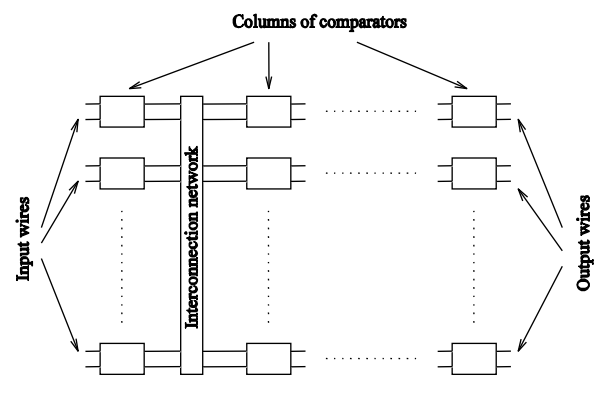
one thread sorting a pair; n/2 threads working simultaneusly
CUDA Implementation using one thread
__device__ void swap(int *x, int *y)
{
  int temp = *x;
  *x = *y;
  *y = temp;
}

__global__ void sort(int a[], int start, int len, int distance,  bool ascending)
{
  ....
     swap(&a[i], &a[i + distance]);
}

void bitonicSort(int a[], int n)
{
  int *da;
  int  aSize = n * sizeof( int );

  cudaMalloc(&da, aSize);
  cudaMemcpy(da, a, aSize, cudaMemcpyHostToDevice);
  ....
    sort<<<1, 1>>>(da, start, len, distance, ascending);
    cudaDeviceSynchronize();
  ....
  cudaMemcpy(a, da, aSize, cudaMemcpyDeviceToHost);
  cudaFree(da);

}
|
__global__ void sort(int a[], int start, int len, int distance,  bool ascending)
{
  int i = threadIdx.x + blockDim.x * blockIdx.x; //thread id
  if ( i >= start &&  i < start + len - distance )
    if ((ascending && a[i] > a[i + distance]) ||
         (!ascending && a[i] < a[i + distance]))
      swap(&a[i], &a[i + distance]);
}

void bitonicSort(int a[], int n)
{
   .....
   int nThreads = 256;   //number of threads in a block
   int nBlocks = ceil((float) n / nThreads);     //number of blocks

      for (...) {
        for (...) {
      	     ..
       	  sort<<< nBlocks, nThreads>>>(da, start, len, distance, ascending);
	}
     }
     ....
}
|