A Simple GPT-style AI Transformer in C/C++
Materials available at: https://forejune.co/cuda/
Review
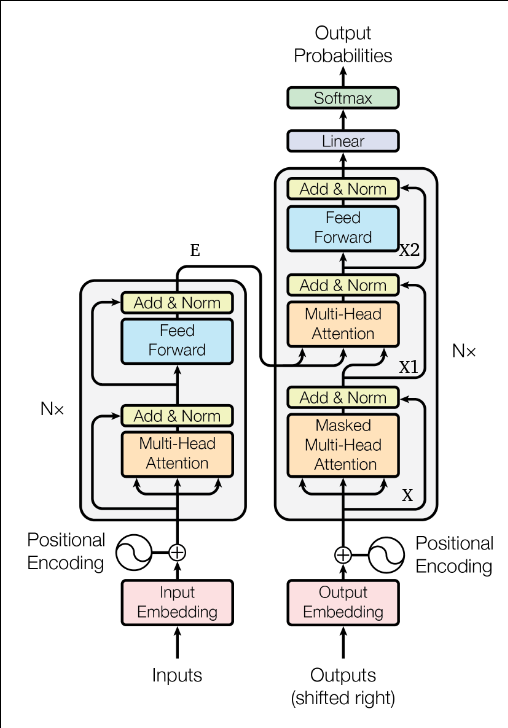
|
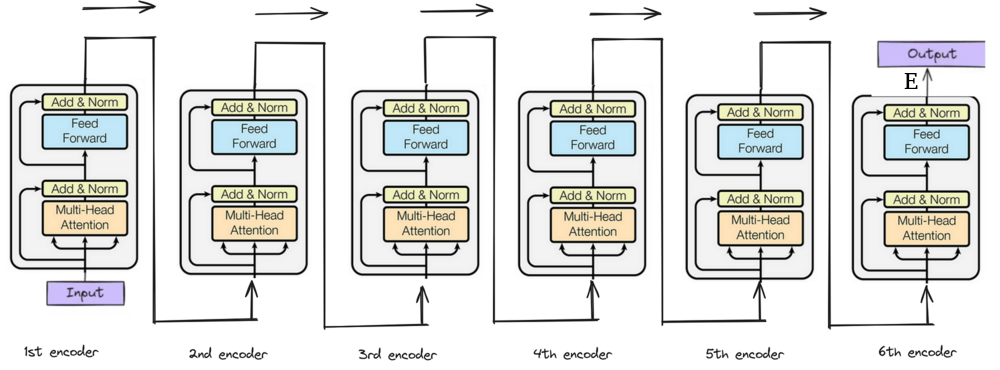
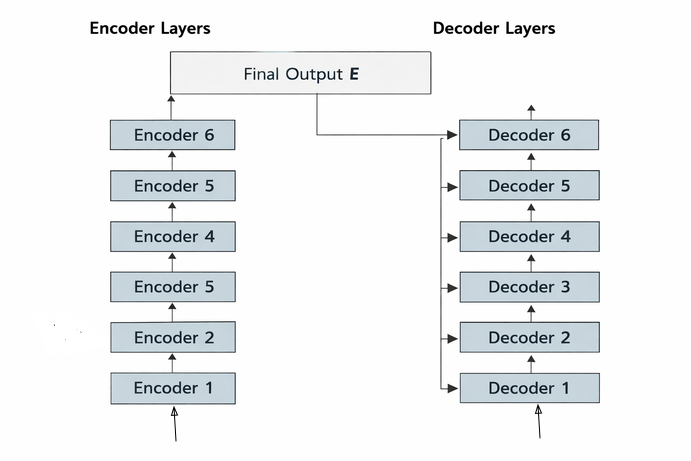
|
Decoder-Only (GPT-style) Transformer
The Model:
Advantages:
- Simpler architecture
- Unified framework (very flexible)
text --> text continuation
e.g.- translation
- summarization
- code generation
- Efficient inference (with caching)
- Scales very well
-
more data + bigger model --> better performance
- No alignment requirement
-
Encoder-decoder needs: (source, target) pairs
GPT can use: any raw text
Disadvantages:
- Not naturally suited for input-output tasks
Translation ideally wants:-
source --> target (explicit separation)
-
source <SEP> target
separation is implicit, not structural - Requires masking tricks
One has to do:-
loss masking: only target contributes
-
clean separation: no masking needed
- Less efficient for long inputs
- Weaker alignment for translation
- Exposure bias in generation
- Needs more data
When Decoder-Only Works Best:
-
Ideal for:
- language modeling
- chat systems
- code generation
- general-purpose AI
- strict translation
- structured input-output tasks
- low-data scenarios
Less ideal for:
Summary:
Feature Decoder-Only (GPT) Encoder-Decoder Architecture Simple More complex Flexibility Very high Medium Translation quality Good Better Training data Unstructured OK Needs pairs Efficiency (long input) Lower Better Implementation Easier Harder |
Full Implementation in C/C++
Helper Functions:
#ifndef __UTIL_H__ #define __UTIL_H__ #include <vector> #include <algorithm> #include <math.h> #include <iostream> #include <iomanip> #include <random> using namespace std; typedef vector<vector<double>> matrixd; // an activation function double f(double z); // Relu activation function with matrix input matrixd relu(const matrixd &X); // Derivative of Relu matrixd relu_deriv (const matrixd &X); // calculates entropy loss double crossEntropy(const matrixd &P, const vector<int> &target); // add two matrices matrixd addMat(const matrixd &A, const matrixd &B); // Transpose matrix n x m, B = A^T : m x n matrixd transpose(const matrixd& A); // Matrix multiplication C = A X B A: nxm, B: mxr, C: nxr matrixd matmul(const matrixd& A, const matrixd& B); // multiply a matrix by a scalar matrixd mulMats (const matrixd &A, const double s); // scale a matrix void scaleMat(matrixd &A, const double s); // apply masking to S matrixd causalMask(matrixd S); // update weight matrix W -= dW * eta void updateWeight(matrixd &W, const matrixd &dW, const double eta); // initialize an input matrix with certain random values void initMatrix(matrixd& M, const int n, const int m); void initMatrix(matrixd& M, const int n, const int m, double dModel); // print a token dictionary void printDictionary(unordered_map<string, int> &d); // print a matrix void printMatrix(const matrixd &y); // Add & Norm matrixd addNnorm(const matrixd &A, const matrixd &B); void clip(matrixd &A, double max_val); // softmax, 1D vector input vector<double> softmax(const vector<double> &v); // softmax activation function, 2D input vector matrixd softmax(const matrixd& input); // derivative function of softmax matrixd softmax_derivative(const matrixd &dL_dP, const matrixd &P); #endif |
util.cpp:
// util.cpp: helper functions
// https://forejune.co/cuda/
#include "util.h"

#include <random>

using namespace std;

// Activation function: using ReLU (Rectified Linear Unit)
double f(double z)
{
  return max(0.0, z);
}

// Relu activation function with matrix input
matrixd relu(const matrixd &X)
{
    int rows = X.size();
    int cols = X[0].size();
    matrixd Y = X;	// same dimension of X

    for(int i = 0; i < rows; i++)
        for(int j = 0; j < cols; j++)
            Y[i][j] = max(0.0, X[i][j]);

    return Y;
}

// Derivative of Relu
matrixd relu_deriv(const matrixd &X)
{
    int rows = X.size();
    int cols = X[0].size();
    matrixd Y = X;	// same dimension as X

    for(int i = 0; i < rows; i++)
        for(int j = 0; j < cols; j++)
	  if ( X[i][j] > 0 )
            Y[i][j] = 1;
	  else
            Y[i][j] = 0;

    return Y;
}

// calculates entropy loss
double crossEntropy(const matrixd &P, const vector<int> &target)
{
  double L = 0;
  int nt = P.size();
  for (int i = 0; i < nt; i++){
    int k = target[i];
    L -= log( P[i][k] + 1e-12 );
  }

  return L / nt;
}

// C = A + B
matrixd addMat(const matrixd &A, const matrixd &B)
{
     int n = A.size();          // rows
     int m = A[0].size();       // cols

     matrixd C = A;       // same dimension as A
     for (int i = 0; i < n; i++)
       for(int j = 0; j < m; j++)
         C[i][j] = A[i][j] + B[i][j];

     return C;
}

// Transpose matrix n x m, B = A^T : m x n
matrixd transpose(const matrixd& A)
{
   int n = A.size();    //number of rows
   int m = A[0].size(); //number of columns

   matrixd B(m, vector<double>(n));
   for (int i = 0; i < n; i++)
     for (int j = 0; j < m; j++)
       B[j][i] = A[i][j];

   return B;
}

// Matrix multiplication   C = A X B   A: nxm, B: mxr, C: nxr
matrixd matmul(const matrixd& A, const matrixd& B)
{
  int n  = A.size();
  int m = A[0].size();
  int r = B[0].size();

  matrixd C(n, vector<double>(r, 0));

  for (int i = 0; i < n; i++)
    for (int j = 0; j < r; j++)
      for (int k = 0; k < m; k++)
        C[i][j] += A[i][k] * B[k][j];

   return C;
}

// scale a matrix
void scaleMat(matrixd &A, const double s)
{
   int m = A.size();	// number of rows
   int n = A[0].size();    // number of columns

   for (int i = 0; i < m; i++)
     for (int j = 0; j < n; j++)
       A[i][j] *= s;
}

// maultiply a matrix by a scalar s
matrixd mulMats (const matrixd &A, const double s)
{
   int m = A.size();	// number of rows
   int n = A[0].size();    // number of columns

   matrixd B = A;

   for (int i = 0; i < m; i++)
     for (int j = 0; j < n; j++)
       B[i][j] *= s;

   return B;
}

void initMatrix(matrixd& M, const int n, const int m)
{
   // resizing 2D vector to n x m with initial values 0
   M.assign(n, vector<double>(m, 0));
   random_device rd;
   mt19937 gen(rd());      //psuedo random number generator
   double sigma = 1.0/16.0;
   normal_distribution<double> dist(0.0, sigma);
   for (int i = 0; i < n; ++i)
     for (int j = 0; j < m; ++j)
        M[i][j] = dist(gen);
}

void printDictionary(unordered_map<string, int> &d)
{
  unordered_map<string, int>::iterator it = d.begin();
  int k = 0;
  while ( it != d.end() ){
    cout << right << setw(12) << it->first << ": " << setw(3) << it->second;
    it++;
    k++;
    if ( k % 5 == 0 )
      cout << endl;
  }
}

void printMatrix(const matrixd &y)
{
    int cols = y.size();
    int rows = y[0].size();

    for (int i = 0; i < cols; ++i) {
        cout << "Token " << i << ": [";
        for (int j = 0; j < rows; ++j) {
            cout << fixed << setw(7) << setprecision(3) << y[i][j];
            if (j < 4) cout << ", ";
        }
        cout << " ]\n";
    }
}

matrixd addNnorm(const matrixd &A, const matrixd &B)
{
     auto x = addMat(A, B);     // add two matrices
     int n = x.size();          // rows
     int m = x[0].size();       // cols
     matrixd y = x;             // output same size as x

     // normalize the result
     double epsilon = 1e-5;

     for (int i = 0; i < n; i++) {
       double sum = 0;          // sum of one row
       double std = 0;          //sigma_i square
       for (int j = 0; j < m; j++)
         sum += x[i][j];
        double mean = sum / m;  // mu_i, mean of i-th row

        sum = 0;
        for (int j = 0; j < m; j++) {
          double diff = x[i][j] - mean;
          sum += diff * diff;
        }
        std = sum / m;
        for (int j = 0; j < m; j++) {
          double xd = (x[i][j] - mean) / sqrt(std + epsilon);
          y[i][j] = xd;         // gamma = 1, beta = 0;
        }
     }

     return y;  // final output of Add & norm
}


matrixd scaledAttention(const matrixd &Q, const matrixd &K, const matrixd &V,
        bool mask)
{
  double d_k, scale;
  matrixd KT, A;	// K transpose, attention

  d_k = Q[0].size();
  scale = 1.0 / sqrt( d_k );
  KT = transpose ( K );
  A = matmul(Q, KT);
  scaleMat(A, scale);

  if ( mask ) {
     for (int i = 0; i < A.size(); i++)
       for (int j = i+1; j < A[0].size(); j++)
         A[i][j] = -1e9;	// causal mask
  }

  A = softmax( A );

  matrixd output = matmul(A, V);

  return output;
}

matrixd causalMask(matrixd S)
{
    int n = S.size();
    for (int i = 0; i < n; i++) {
        for (int j = i+1; j < n; j++) {
            S[i][j] = -1e9;  // effectively -infinity
        }
    }
    return S;
}

void updateWeight(matrixd &W, const matrixd &dW, const double eta)
{
   for (int i = 0; i < W.size(); i++)
     for (int j = 0; j < W[0].size(); j++)
         W[i][j] -= eta * dW[i][j];
}

void clip(matrixd &A, double max_val = 5.0)
{
    for (auto &row : A)
        for (auto &x : row)
            if (x > max_val) x = max_val;
            else if (x < -max_val) x = -max_val;
}

// softmax activation function, 1D input vector
vector<double> softmax(const vector<double> &z)
{
  int m = z.size();
  vector<double> y(m, 0);

   //maximum value of vector
  double maxVal = *max_element(z.begin(), z.end());

  double sum = 0;
  // Subtract max for numerical stability
  for (int j = 0; j < m; j++) {
    y[j] = exp(z[j] - maxVal);
    sum += y[j];
  }

  // Normalize
  for (int j = 0; j < m; j++)
    y[j] /= sum;

  return y;
}

// softmax activation function, 2D input vector
matrixd softmax(const matrixd& input)
{
  int n = input.size(), m = input[0].size();    // n x m matrix

  // 2D output vector n x m y[n][m]
  vector<vector<double>> y(n, vector<double>(m));

  for (int i = 0; i < n; i++) {
    //maximum value of the row
    double maxVal = *max_element(input[i].begin(), input[i].end());

    double sum = 0;
    // Subtract max for numerical stability
    for (int j = 0; j < m; j++) {
      y[i][j] = exp(input[i][j] - maxVal);
      sum += y[i][j];
    }

    // Normalize
    for (int j = 0; j < input[i].size(); j++)
      y[i][j] /= sum;
  }

  return y;
}

// derivative function of softmax
matrixd softmax_derivative(const matrixd &dL_dP, const matrixd &P)
{
    int nt = P.size(), ns = P[0].size();
    matrixd dL_dS(nt, vector<double>(ns,0));

    for (int i = 0; i < nt; i++)
    {
          double dot = 0.0;
          for (int j = 0; j < ns; j++)
            dot += P[i][j] * dL_dP[i][j];  // dot product of two row-vectors

          for (int j = 0; j < ns; j++)  // dot used by all columns of dL/dA
             dL_dS[i][j] = P[i][j] * (dL_dP[i][j] - dot);
    }

    return dL_dS;
} |
Transformer Classes:
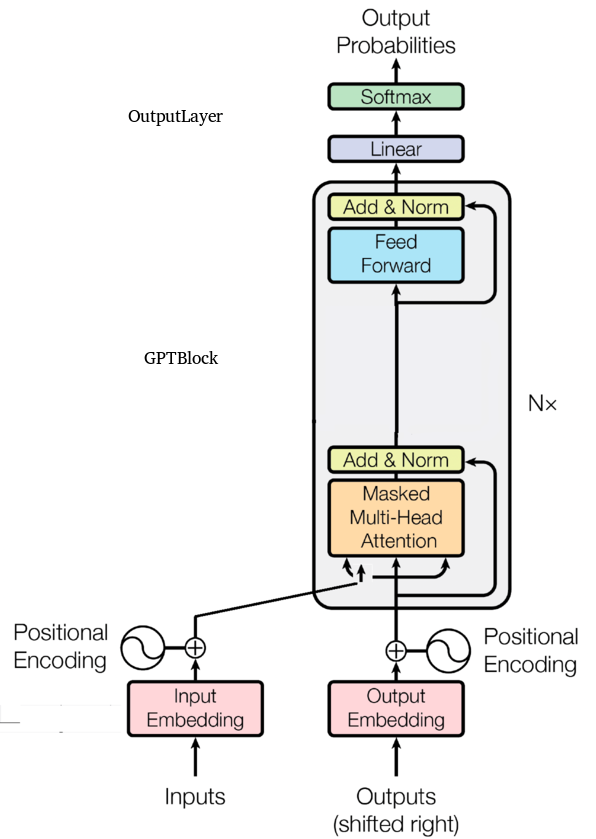
transGpt.h:
#ifndef TRANSGPT_H
#define TRANSGPT_H
class Tokenizer
{
private:
    unordered_map<string, int> words;
    unordered_map<int, string> wordIndex;
    int nTokens;        // number of words

    // special tokens
    const string PAD = "<PAD>";
    const string UNK = "<UNK>";
    const string BOS = "<BOS>";
    const string EOS = "<EOS>";
    const string SEP = "<SEP>";

    void addWord(const string &w)
    {
        if (words.find(w) == words.end()) {
            int id = nTokens;
            words[w] = id;
            wordIndex[id] = w;
            nTokens++;
        }
    }

    vector<string> split(const string &str)
    {
        vector<string> tokens;
        stringstream ss(str);
        string word;
        while (ss >> word) {
            tokens.push_back(word);
        }
        return tokens;
    }

public:
    Tokenizer();
    Tokenizer(ifstream &fs);
    unordered_map<string, int>  getTokensWords();
    vector<int> tokenize(const string& str);
    string detokenize(const vector<int>& tokenIDs);
    int get_nTokens() const;
    unordered_map<int, string> get_wordIndex();
};

class Embedding
{
private:
    int nTokens;        // number of words
    int dim;            // embedding dimension
    matrixd em_matrix;  // embedding matrix;
public:
    Embedding(int sequence_length, int embeddingDimension);
    // create embedding matrix with tokenIDs
    matrixd embed(const vector<int>& tokenIDs);
    int get_embedDim() const;
    int get_nTokens() const;
};

// Positional Encoding
class PositionalEncoding
{
private:
    int maxTokens; // maximum sequence length
    int dModel;    // embedding dimension
    matrixd PE;    // positional_encodings matrix;
public:
    PositionalEncoding(int max_seq_length, int embedding_dimension);
    matrixd addPE(const matrixd& embeddings);
    matrixd getPE();
};

// Add & Norm
class AddnNorm
{
private:
    vector<double> gamma;   // size dModel
    vector<double> beta;    // size dModel

    matrixd Zhat;           // normalized values (nt x d)
    vector<double> mean;    // per row (nt)
    vector<double> var;     // per row (nt)

    double eps;             // small value

public:
   // constructor
   AddnNorm(int dModel);

   // forward computation
   matrixd  forward (const matrixd &A, const matrixd &B);

   // Assume forward already filled: Zhat, mean, var
   matrixd backProp(const matrixd &X, const matrixd &dL_dY, double eta);

   // Optional setters (to plug in forward results)
   void setCache(const matrixd& zhat, const vector<double>& m,
                  const vector<double>& v);

    // Accessors (optional)
    const vector<double>& getGamma();
    const vector<double>& getBeta();
};

// Feed-forward Network
class FeedForward
{
private:
    matrixd W1, W2;
    int dModel, d_ff;

    // cache
    matrixd F1;   // after activation function ReLU
    matrixd Z;    // before ReLU (needed for derivative)

public:
    // constructor
    FeedForward(int dModel, int d_ff_);
    // ------------------------------
    // Forward (for cache)
    // ------------------------------
    matrixd FFoutput(const matrixd &X);
 // ------------------------------
    // Backprop
    // ------------------------------
    matrixd backProp(const matrixd &X, const matrixd &dL_dY,  double eta);
};

// ----------- MultiHeadAttention -----------
class MultiHeadAttention {
private:
    int dModel, nHeads, d_k;

    vector<matrixd> WQ, WK, WV; // per head
    matrixd WO;

    // cache
    vector<matrixd> Qs, Ks, Vs, Ps, As;
public:
    MultiHeadAttention(int dModel, int nHeads);
    matrixd computeAttention(const matrixd &X_Q, const matrixd &X_K, const matrixd &X_V,
                             bool mask);
     matrixd backProp( const matrixd &X_Q, const matrixd &X_K, const matrixd &X_V,
        const matrixd &dL_dH, double eta, bool mask);
};

// ----------------- OutputLayer ---------------
class OutputLayer {
private:
    matrixd W;   // dModel x vocab_size
    int dModel, vocab_size;

public:
    OutputLayer(int dModel, int vocab_size);
    matrixd forward(const matrixd &X);
    matrixd backward(const matrixd &X, const matrixd &P,
                     const vector<int> &targets, double eta);
};

// ------------------- GPT-style Transformer ---------------
class GPTBlock {
private:
    MultiHeadAttention mha;
    AddnNorm norm1;
    FeedForward ffn;
    AddnNorm norm2;

public:
    GPTBlock(int dModel, int nHeads, int d_ff);
    matrixd forward(const matrixd &X);
    matrixd backward(const matrixd &X, const matrixd &dL_dY, double eta);
};

class MiniGPT {
private:
    Embedding embed;
    PositionalEncoding pe;
    vector<GPTBlock> layers;
    OutputLayer output;

    int seq_len, vocab_size;

public:
    MiniGPT(int vocab_size, int seq_len, int dModel,
		    int nHeads, int d_ff, int nLayers);
    matrixd forward(const vector<int> &tokens);
    double trainStep(const vector<int> &tokens, double eta);
};
#endif
|
transGpt.cpp:
// https://forejune.co/cuda
// transGpt.cpp : classes of GPT-style Transformer
#include <iostream>
#include <fstream>
#include <vector>
#include <string>
#include <unordered_map>
#include <cmath>
#include <random>
#include <algorithm>
#include <iomanip>
#include "util.h"
#include "transGpt.h"
using namespace std;
// ------------------------ Tokenizer class --------------------------
// -------------------------------
// Default constructor
// -------------------------------
Tokenizer::Tokenizer()
{
nTokens = 0;
// Initialize special tokens first
addWord(PAD); // 0
addWord(UNK); // 1
addWord(BOS); // 2
addWord(EOS); // 3
addWord(SEP); // 4
}
// -------------------------------
// Build vocab from file
// -------------------------------
Tokenizer::Tokenizer(ifstream &fs) : Tokenizer()
{
string line;
while (getline(fs, line)) {
vector<string> tokens = split(line); //split(line);
for (int i = 0; i < tokens.size(); i++)
addWord(tokens[i]);
}
}
unordered_map<string, int> Tokenizer::getTokensWords()
{
return words;
}
vector<int> Tokenizer::tokenize(const string& str)
{
vector<int> ids;
vector<string> tokens = split(str);
for (int i = 0; i < tokens.size(); i++) {
string w = tokens[i];
if (words.find(w) != words.end())
ids.push_back(words[w]);
else
ids.push_back(words[UNK]);
}
return ids;
}
string Tokenizer::detokenize(const vector<int>& tokenIDs)
{
string words;
int n = tokenIDs.size();
for (int i = 0; i < n; i++) {
int id = tokenIDs[i];
if (wordIndex.find(id) == wordIndex.end())
continue;
string w = wordIndex[id];
// Skip special tokens (optional behavior)
if (w == "<PAD>" || w == "<BOS>" || w == "<EOS>")
continue;
words += w + " ";
}
return words;
}
int Tokenizer::get_nTokens() const
{
return nTokens;
}
unordered_map<int, string>Tokenizer::get_wordIndex()
{
return wordIndex;
}
//------------------ Embedding Class ------------------
Embedding::Embedding(int sequence_length, int embeddingDimension)
{
nTokens = sequence_length;
dim = embeddingDimension;
// initialize embeddings as an nTokensxdim matrix with certain random values
initMatrix(em_matrix, nTokens, dim);
}
// create embedding matrix with tokenIDs
matrixd Embedding::embed(const vector<int>& tokenIDs)
{
matrixd embeddings;
embeddings.reserve(tokenIDs.size()); // set capacity of embeddings vector
for(int i = 0; i < tokenIDs.size(); i++) {
if (tokenIDs[i] >= 0 && tokenIDs[i] < nTokens)
embeddings.push_back(em_matrix[tokenIDs[i]]);
else
// Out-of-dictionary tokens
embeddings.push_back(vector<double>(dim, 0.0));
}
return embeddings;
}
int Embedding::get_embedDim() const
{
return dim;
}
int Embedding::get_nTokens() const
{
return nTokens;
}
// --------------------- Positional Encoding class ---------------
PositionalEncoding::PositionalEncoding(int max_seq_length, int embed_dimension)
{
maxTokens = max_seq_length;
dModel = embed_dimension;
PE.resize(maxTokens, vector<double>(dModel));
for (int pos = 0; pos < maxTokens; pos++) {
for (int i = 0; i < dModel/2; i++) {
PE[pos][2*i] = sin( pos / pow(10000, 2.0*i/dModel) );
PE[pos][2*i+1] = cos( pos / pow(10000, 2.0*i/dModel) );
}
}
}
// add positional encodings to embeddings
matrixd PositionalEncoding::addPE(const matrixd& embeddings)
{
matrixd x = embeddings;
int nTokens = embeddings.size();
for (int pos = 0; pos < nTokens; pos++)
for (int i = 0; i < dModel; i++)
x[pos][i] += PE[pos][i];
return x;
}
matrixd PositionalEncoding::getPE()
{
return PE;
}
// -------------------- Add & Norm Class---------------------------------
// constructor
AddnNorm::AddnNorm(int dModel)
{
gamma.assign(dModel, 1.0);
beta.assign(dModel, 0.0),
eps = 1e-5;
}
matrixd AddnNorm::forward (const matrixd &A, const matrixd &B)
{
matrixd x = addMat(A, B); // add two matrices
int n = x.size(); // rows
int m = x[0].size(); // cols
mean.resize( n );
var.resize( n );
Zhat.resize(n, vector<double>(m, 0));
matrixd Y(n, vector |
testMain.cpp:
// https://forejune.co/cuda/
// testMain.cpp

#include "util.h"
#include "transGpt.h"
#include <fstream>

using namespace std;

vector<int> generate(MiniGPT &model, vector<int> prompt, int max_len)
{
    vector<int> tokens = prompt;

    for (int step = 0; step < max_len; step++) {
	vector<int> input(tokens.begin(), tokens.end());
        matrixd P = model.forward(input);

        vector<double> last = P.back();   //last row of matrix P
	// last contains probability distribution over the vocabulary for the next token
	// each index in last corresponds to a token ID in the vocabulary

	// greedy decoding, - last.begin() converts interator to index
        int next = max_element(last.begin(), last.end()) - last.begin();

        tokens.push_back(next);
    }

    return tokens;
}

vector<vector<int>> buildDataset(Tokenizer &tokenizer)
{
    vector<vector<int>> dataset;

    string str = "one two three  uno  dos  tres";
    vector<int> tokenIDs = tokenizer.tokenize(str);
    dataset.push_back( tokenIDs );
    str = "two three  four dos  tres  cuatro ";
    tokenIDs = tokenizer.tokenize(str);
    dataset.push_back( tokenIDs );
    str = "three  four  five tres  cuatro  cinco";
    tokenIDs = tokenizer.tokenize(str);
    dataset.push_back( tokenIDs );
    str = "one two three  uno  dos  tres";
    tokenIDs = tokenizer.tokenize(str);
    dataset.push_back( tokenIDs );
    str = "three  four  five tres  cuatro  cinco";
    tokenIDs = tokenizer.tokenize(str);
    dataset.push_back( tokenIDs );

    return dataset;
}

int main()
{
    // -------------------------
    // Tokenizer setup
    // -------------------------

    // Build vocabulary
    ifstream ifs;
    char fname[] = "t.txt";
    ifs.open( fname );
    if (!ifs.is_open()) {
          cerr << "Unable to open file " << fname  << endl;
          exit( 1 );
    }

    Tokenizer tokenizer( ifs );

    int vocab_size = tokenizer.get_nTokens();

    cout << "Vocab size: " << vocab_size << endl;

    // -------------------------
    // Model
    // -------------------------
    int seq_len = 50;	// maximum sequence length model can handle
    int dModel = 32;
    int nHeads = 4;
    int d_ff = 128;
    int nLayers = 2;

    MiniGPT model(vocab_size, seq_len, dModel, nHeads, d_ff, nLayers);

    // -------------------------
    // Dataset
    // -------------------------
    vector<vector<int>> dataset;
    dataset = buildDataset( tokenizer );

    // -------------------------
    // Training
    // -------------------------
    for (int epoch = 0; epoch < 201; epoch++) {
        double loss = 0;

        for (auto &seq : dataset)
            loss += model.trainStep(seq, 0.002);

        if (epoch % 20 == 0)
            cout << "Epoch " << epoch << " Loss: " << loss << endl;
    }

    // -------------------------
    // Inference
    // -------------------------
    string prompt = "one two three";
    vector<int> prompt_tokens = tokenizer.tokenize(prompt);
    cout << "\nPrompt: " << prompt << endl;
    vector<int> generated = generate(model, prompt_tokens, 3);
    string output = tokenizer.detokenize(generated);
    cout << "\nGenerated text:\n" << output << endl;

    prompt = "three four five";
    prompt_tokens = tokenizer.tokenize(prompt);
    cout << "\nPrompt: " << prompt << endl;
    generated = generate(model, prompt_tokens, 3);
    output = tokenizer.detokenize(generated);
    cout << "\nGenerated text:\n" << output << endl;

    return 0;
}
|
Makefile:
PROG = testMain #source codes SRCS = $(PROG).cpp #substitute .cpp by .o to obtain object filenames OBJS = $(SRCS:.cpp=.o) util.o transGpt.o #$< evaluates to the target's dependencies, #$@ evaluates to the target $(PROG): $(OBJS) g++ -o $@ $(OBJS) $(OBJS): g++ -c -std=c++20 $*.cpp clean: rm $(OBJS) $(PROG) |
|
|