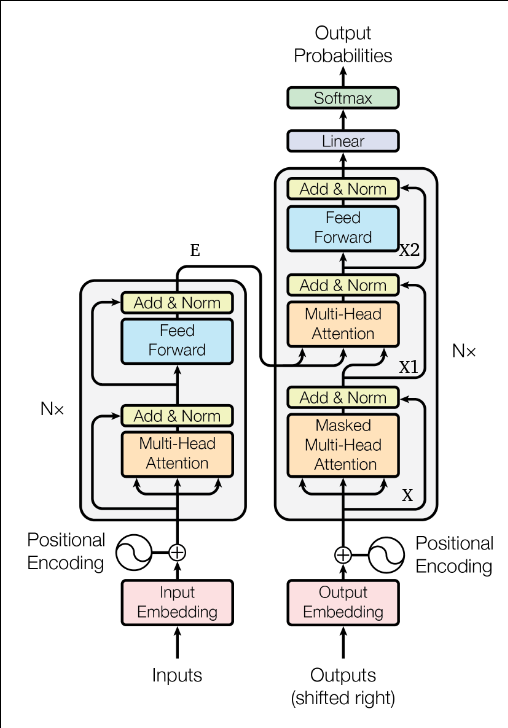
// transformer.cpp -- classes of a multi-head transformer
// https://forejune.co/cuda/

#include <iostream>
#include <fstream>
#include <vector>
#include <string>
#include <unordered_map>
#include <cmath>
#include <random>
#include <algorithm>
#include <iomanip>
#include "util.h"
#include "transformer.h"

using namespace std;

// ------------------------ Tokenizer class --------------------------
Tokenizer::Tokenizer()
{
  // Create a simple dictionary
  words = {
      {"[UNK]", 0}, {"[PAD]", 1}, {"[CLS]", 2}, {"[SEP]", 3},
      {"strong", 4}, {"nation", 5}, {"recycles", 6}, {"its", 7},
      {"huge", 8}, {"trade", 9}, {"surplus", 10}, {"to", 11},
      {"america", 12}, {"to", 13}, {"infiltrate", 14}, {"it", 15}, {"!", 16}
   };

   // Create reverse mapping
   nTokens = words.size();
   unordered_map<string, int>::iterator it = words.begin();
   while ( it != words.end() ) {
     wordIndex[it->second] = it->first;
     it++;
   }
}

Tokenizer::Tokenizer(ifstream &fs)
{
        string token;
        vector<string> tokens;

        // Read tokens (words) one by one, delimited by whitespace
	int k = 0;
	words["[UNK]"] = k;	//unknown token
        wordIndex[k] = "UNK]";
 	k++;
        while (fs >> token) {
	  if (!words.contains(token)){
	    words[token] = k;
	    wordIndex[k] = token;
	    k++;
	  }
        }
	nTokens = words.size();
}

unordered_map<string, int>  Tokenizer::getTokensWords()
{
      return words;
}

// tokenize a string
vector<int> Tokenizer::tokenize(const string& str)
{
   vector<int> tokenIDs;
   string token;

   // Simple tokenization
   for (char c : str) {
     if (isalnum(c)) {
        //change character to lower case, add it to current token string
        token += tolower(c);
      } else {	// non-alpha numeric, form a complete token
        if (!token.empty()) {  //string not empty
          if (words.find(token) != words.end())
	    // token is in the words dictionary, thus save its ID
            tokenIDs.push_back(words[token]);
          else // unknown token
            tokenIDs.push_back(words["[UNK]"]);
              token.clear();	// clear variable to form next token
	  }
                if (c == '!')	// special token
                    tokenIDs.push_back(words["!"]);
        }
      }
      // possible last token
      if (!token.empty()) {
        if (words.find(token) != words.end())
          tokenIDs.push_back(words[token]);
        else
          tokenIDs.push_back(words["[UNK]"]);
        }

        return tokenIDs;
}

// Change a vector of tokens back to text
string Tokenizer::detokenize(const vector<int>& tokenIDs)
{
        string str;

        for (int i = 0; i < tokenIDs.size(); i++) {
            if (wordIndex.find(tokenIDs[i]) != wordIndex.end()) {
                str += wordIndex[tokenIDs[i]];
                // add a delimiter
                if (i < tokenIDs.size() - 1 && wordIndex[tokenIDs[i+1]] != "!")
                    str += " ";
            }
        }

        return str;
}

int Tokenizer::get_nTokens() const
{
      return nTokens;
}

//------------------   Embedding Class ------------------
Embedding::Embedding(int sequence_length, int embeddingDimension)
{
  nTokens = sequence_length;
  dim = embeddingDimension;
  // initialize embeddings as an nTokens x dim matrix with certain random values
  initMatrix(em_matrix, nTokens, dim);
}

// create embedding matrix with tokenIDs
matrixd Embedding::embed(const vector<int>& tokenIDs)
{
      matrixd embeddings;
      embeddings.reserve(tokenIDs.size()); // set capacity of embeddings vector
      for(int i = 0; i < tokenIDs.size(); i++) {
	if (tokenIDs[i] >= 0 && tokenIDs[i] < nTokens)
           embeddings.push_back(em_matrix[tokenIDs[i]]);
	else
          // Out-of-dictionary tokens
          embeddings.push_back(vector<double>(dim, 0.0));
      }

      return embeddings;
}

int Embedding::get_embedDim() const
{
       return dim;
}

int Embedding::get_nTokens() const
{
       return nTokens;
}

// --------------------- Positional Encoding class ---------------
PositionalEncoding::PositionalEncoding(int max_seq_length, int embed_dimension)
{
      maxTokens = max_seq_length;
      dModel = embed_dimension;

      PE.resize(maxTokens, vector<double>(dModel));
      for (int pos = 0; pos < maxTokens; pos++) {
        for (int i = 0; i < dModel/2; i++) {
    		PE[pos][2*i] = sin( pos / pow(10000, 2.0*i/dModel) );
	    	PE[pos][2*i+1] = cos( pos / pow(10000, 2.0*i/dModel) );
	}
      }
}

// add positional encodings to embeddings
matrixd PositionalEncoding::addPE(const matrixd& embeddings)
{
      matrixd x = embeddings;
      int nTokens = embeddings.size();

      for (int pos = 0; pos < nTokens; pos++)
        for (int i = 0; i < dModel; i++)
          x[pos][i] += PE[pos][i];

      return x;
}

matrixd PositionalEncoding::getPE()
{
  return PE;
}

// ------------------------------- Multi-Head Attention Class ---------------
MultiHeadAttention::MultiHeadAttention(int dm, int nh)
{
      dModel = dm;	//embedding dimension
      nHeads = nh; 	//number of heads
      d_k = dModel / nHeads;

      // initialize weight matrices with some random values
      initMatrix(WQ, dModel, dModel);
      initMatrix(WK, dModel, dModel);
      initMatrix(WV, dModel, dModel);
      initMatrix(WO, dModel, dModel);
}

// input Matrix X:  ns (or nt) x dModel
matrixd MultiHeadAttention::computeAttention(const matrixd &X_Q, const matrixd &X_K,
                                             const matrixd &X_V,  bool mask)
{
    matrixd Q = matmul(X_Q, WQ);
    matrixd K = matmul(X_K, WK);
    matrixd V = matmul(X_V, WV);

    vector<matrixd> head_outputs;

    for (int h = 0; h < nHeads; h++) {
       matrixd Qh(Q.size(), vector<double>(d_k));
       matrixd Kh(K.size(), vector<double>(d_k));
       matrixd Vh(V.size(), vector<double>(d_k));
       for (int i = 0; i < Q.size(); i++)
         for (int j = 0; j < d_k; j++)
           Qh[i][j] = Q[i][h*d_k + j];
       for (int i = 0; i < K.size(); i++)
         for (int j = 0; j < d_k; j++)
           Kh[i][j] = K[i][h*d_k + j];
       for (int i = 0; i < V.size(); i++)
         for (int j = 0; j < d_k; j++)
           Vh[i][j] = V[i][h*d_k + j];
       // save attention of each head in a vector
       head_outputs.push_back(scaledAttention(Qh, Kh, Vh, mask));
    }

    // concatenate heads
    matrixd concat(Q.size(), vector<double>(dModel));
    for (int h = 0; h < nHeads; h++)
      for (int i = 0; i < Q.size(); i++)
        for (int j = 0; j < d_k; j++)
           concat[i][h*d_k + j] = head_outputs[h][i][j];

     // muliply by WO to give final output
     auto y = matmul(concat, WO);

     return y;
}

// ---------------------------  Feed Forward -----------------------------------
FeedForward::FeedForward(int d_model, int dFF)
{
    dModel = d_model;
    d_ff = dFF;
    initMatrix(W1, dModel, d_ff);
    initMatrix(W2, d_ff, dModel);
}

matrixd FeedForward::FFoutput(const matrixd &X)
{
    matrixd z = X;       // output same size as x
    auto A = matmul(X, W1);	// A = X x W1
    matrixd y = A;       // same matrix size
    int n = A.size();    // rows
    int m = A[0].size(); // cols
    for (int i = 0; i < n; i++)
       for(int j = 0; j < m; j++)
	 y[i][j] = f(A[i][j]);	// f is an activation function

     z = matmul(y, W2);		// z = y x W2

     return z;   // output of FeedForward
}

void FeedForward::updateWeights(const matrixd &dW1, const matrixd &dW2)
{
    W1 = addMat(W1, dW1);
    W2 = addMat(W2, dW2);
}
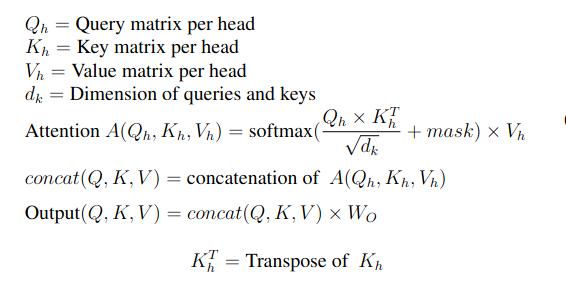 Q x KT : nt x nt
Every token attends to every previous token
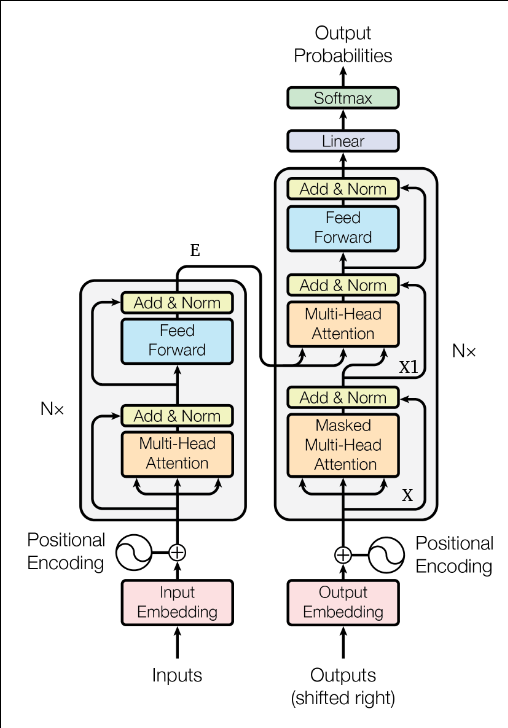
Let MHA(X) = Output = concat(Q,K,V) x WO
4. Add & Norm:
X1 = Normalize(X + MHA(X))
X1 : nt x dmodel
Q x KT : nt x nt
Every token attends to every previous token
Let MHA(X) = Output = concat(Q,K,V) x WO
4. Add & Norm:
X1 = Normalize(X + MHA(X))
X1 : nt x dmodel